



Custom Software Development in Mexico: How U.S. Businesses Can Build Smarter Solutions
What if your business could get software built around the way your team actually works instead of forcing employees to adapt to a generic platform? That is the appeal behind custom software development in Mexico, especially for U.S. companies looking for skilled development talent, flexible delivery models, and cost-conscious technology strategies. Mexico has become an attractive nearshore destination because its developers can collaborate with U.S. teams across relatively convenient time zones while serving a growing technology market. But choosing a development partner is not simply about finding the lowest price. The real goal is to build secure, scalable software that solves a measurable business problem and continues delivering value as your company grows.
Why Are U.S. Companies Looking at Mexico for Software Development?
Building software in-house can be expensive, particularly when a project requires several specialists. A company may need developers, UI/UX designers, QA engineers, cloud professionals, project managers, and security expertise at different stages.
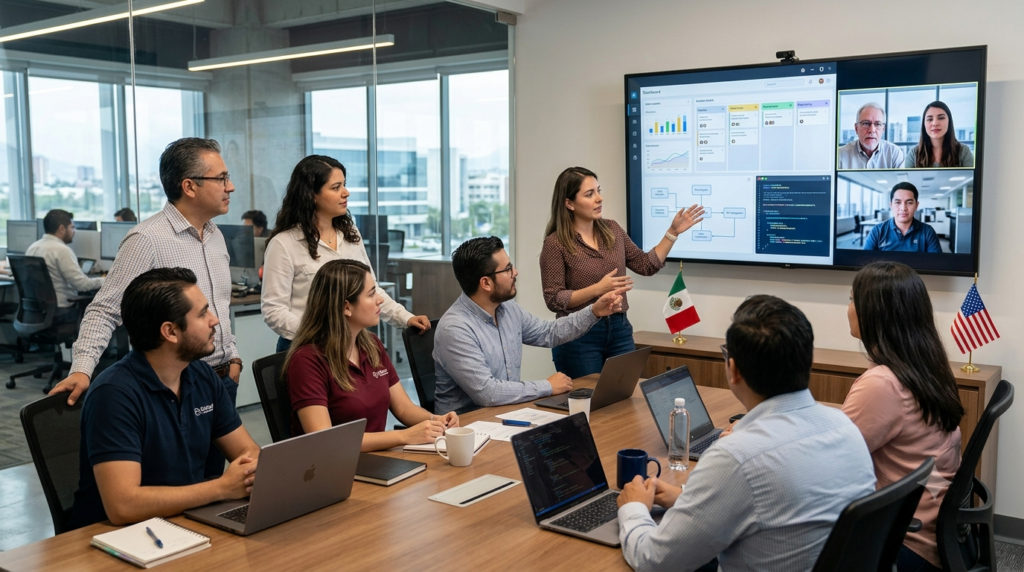
Mexico offers U.S. businesses a nearshore alternative. Geographic proximity can make collaboration easier than working with teams separated by large time differences. Teams can schedule meetings during overlapping business hours, discuss requirements in real time, and resolve issues without waiting until the next day.
For example, imagine a Texas-based logistics company developing a fleet management platform. A nearshore Mexican development team could work during overlapping hours with the company’s operations and product teams, making it easier to review dashboards, API integrations, mobile features, and testing results throughout the development cycle.
What Does Custom Software Development in Mexico Include?
Custom development goes beyond writing code. It involves understanding a company’s processes, identifying technology gaps, designing a solution, developing the application, testing it, deploying it, and improving it over time.
Depending on business requirements, a project might include web applications, mobile apps, customer portals, enterprise platforms, cloud applications, APIs, workflow automation, or integrations with existing systems.
A healthcare organization, for instance, might need a secure application that connects appointment scheduling, internal workflows, reporting, and customer communication. Rather than purchasing several unrelated tools, the company can create a solution designed around its specific operational requirements.
The important question is not, “What software can we build?” It is, “What business problem should the software solve?”
How to Choose the Best Software Services in Mexico
Finding a development company is easy. Finding the right one takes more research.
Start by evaluating technical experience. Look for teams that understand the technologies your project requires, whether that involves cloud computing, mobile development, enterprise applications, artificial intelligence, data systems, or third-party integrations.
Next, examine the company’s development process. A reliable partner should be able to explain how it handles requirements, architecture, development, testing, deployment, security, documentation, and ongoing maintenance.
Communication matters just as much. Ask how often you’ll receive project updates, who your primary contact will be, how changes are managed, and which collaboration tools the team uses.
Finally, review relevant case studies and references. A portfolio can show what a company has built, but real project outcomes can tell you much more about its reliability and problem-solving ability.
Software Services in Mexico for Growing Businesses
Not every company needs a massive enterprise platform. Sometimes the biggest opportunity is automating one frustrating process.
Consider a growing distributor that manages orders through spreadsheets and email. As the company expands, employees spend hours checking information, updating records, and sending status messages. A custom internal application could centralize those workflows and automate repetitive tasks.
This is where software services in Mexico can support businesses at different stages. Services may cover application development, cloud modernization, system integration, software testing, maintenance, UI/UX design, and business process automation.
The best solution is usually the one that removes a specific bottleneck rather than adding technology simply because it is popular.
Key Benefits of Nearshore Development
One of the biggest advantages of working with a Mexican development team is collaboration. When U.S. and Mexican teams share overlapping working hours, product discussions can happen in real time.
Cost efficiency can also be important. Outsourcing development may allow companies to access specialized talent without immediately building a large internal engineering department. However, businesses should compare the total value of a partnership rather than focusing only on hourly rates.
Cultural and geographic proximity can provide another advantage. In-person meetings may be more practical than with teams located on another continent, while frequent communication can help reduce misunderstandings around project requirements.
These benefits do not guarantee a successful project. Clear requirements, strong project management, security practices, and transparent communication still determine the outcome.
Security Should Be Part of the Project From Day One
Security should never be treated as a final checklist item.
Before development begins, discuss authentication, authorization, encryption, data handling, backups, access controls, vulnerability testing, and regulatory requirements relevant to the business.
For example, an application handling sensitive customer information may require stronger access controls than a simple marketing website. The development team should understand these requirements before architecture and database decisions are finalized.
A trustworthy partner should also explain how code is reviewed, vulnerabilities are identified, dependencies are managed, and production access is controlled.
How Much Does Custom Software Development Cost?
There is no single price for a custom software project. The cost depends on the application’s complexity, number of features, integrations, platforms, security requirements, design needs, development timeline, and post-launch support.
A small business dashboard may require far less investment than a multi-tenant enterprise platform with mobile applications, complex integrations, analytics, and advanced security.
Instead of asking only, “How much will it cost?” ask, “What will we receive for that investment?”
A good development partner should provide a clear scope, explain assumptions, identify major deliverables, and communicate how changes could affect the timeline and budget.
A Practical Development Process
A successful project usually starts with discovery. Business stakeholders and developers define objectives, users, workflows, technical requirements, and success metrics.
The next stage may involve UX planning and architecture. Designers create user flows and interfaces while technical teams determine how the application will work behind the scenes.
Development then happens in manageable stages. Regular demonstrations allow stakeholders to review progress before the entire application is completed.
Testing follows throughout the project rather than being postponed until the final week. After deployment, monitoring, maintenance, security updates, and feature improvements help keep the software reliable.
This iterative approach reduces surprises and gives businesses more opportunities to provide feedback.
FAQs
Is Mexico a good option for U.S. software development projects?
Yes. Mexico can be a practical nearshore option for U.S. businesses because of geographic proximity, overlapping working hours, and access to a growing technology talent pool. The right partner still depends on technical expertise, communication, security, and project experience.
How do I choose a software development company in Mexico?
Look at technical capabilities, relevant case studies, communication processes, security practices, development methodology, pricing transparency, and post-launch support. Ask specific questions about how the company would approach your particular project.
Is custom software better than off-the-shelf software?
Not always. Off-the-shelf software can be a good choice when it already meets your requirements. Custom software becomes more attractive when your workflows are unique, existing tools do not integrate well, or your business needs capabilities that standard products cannot provide.
Can a Mexican development team work with a U.S. company remotely?
Yes. Many development teams work with international clients using video conferencing, project management platforms, code repositories, and collaboration tools. Time-zone overlap can make nearshore collaboration particularly convenient.
What should I prepare before contacting a development company?
Start with the business problem, target users, essential features, existing systems, desired timeline, and approximate budget. You do not need a complete technical specification. A capable development partner can help turn your business requirements into a practical technical plan.
Conclusion
Choosing a development partner is ultimately about more than location or price. U.S. businesses should look for a team that understands their goals, communicates clearly, follows sound engineering practices, and builds software that can evolve with the business. Custom software development in Mexico can provide a practical nearshore path for companies that want specialized development capabilities without sacrificing collaboration.
Ready to turn a business challenge into a practical software solution? Start by defining your biggest workflow problem, the users affected by it, and the outcome you want to achieve. Then speak with a qualified Mexican development partner to discuss requirements, technology options, timeline, security, and budget.
Connect with us in LinkedIn









Leave a Reply