



Why Enterprise Custom Software Development in the USA Beats Off-the-Shelf Every Time
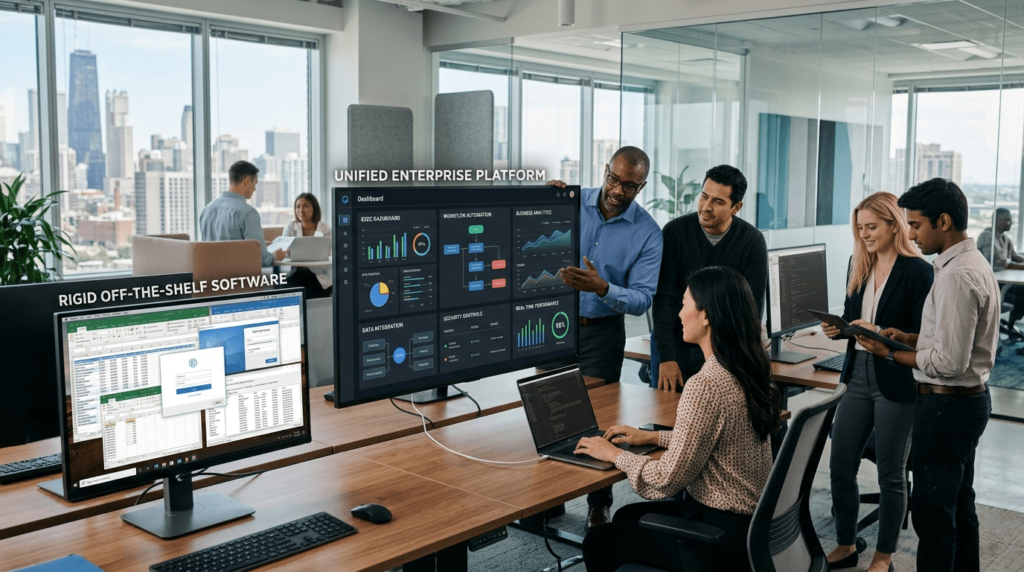
Ever bought software that almost fit your business, then spent six months bending your workflows around it instead of the other way around? You’re not alone. Most companies eventually hit a wall with generic tools, and that’s exactly when enterprise custom software development USA becomes the smarter path forward. Instead of forcing your team to adapt to rigid features built for someone else’s problems, you get a system shaped around how you actually work.
This isn’t just a developer preference — it’s a business decision with real financial weight. Off-the-shelf platforms charge you for features you’ll never touch while missing the one workflow that would actually save you hours every week. Custom-built systems flip that equation entirely. Stick around, because we’re breaking down what this really looks like, what it costs, and how to know if it’s right for you.
What “Custom” Actually Means (And Why It Matters)
Custom doesn’t mean “built from nothing every single time.” It means software architected around your specific processes, data, and goals — not a generic template with your logo slapped on top. A logistics company might need real-time fleet tracking baked into their inventory system. A healthcare provider might need HIPAA-compliant patient scheduling that talks directly to their billing software.
Generic tools can’t do that kind of deep integration. They’re built to serve thousands of different businesses at once, which means every feature is a compromise. Custom application development USA firms build for one client, one workflow, one outcome — and that focus shows up in the results.
The Real Cost of Sticking with Generic Software
Here’s something most companies don’t calculate until it’s too late: the hidden cost of workarounds. Every manual export, every duplicate data entry, every “we’ll just deal with it” moment adds up. A mid-size retailer we’ve seen in industry case studies lost roughly 15 hours a week to manual inventory reconciliation because their off-the-shelf system couldn’t sync with their point-of-sale platform.
That’s not a software problem — that’s a lost-revenue problem. Multiply 15 hours by a team’s hourly cost, and you’re looking at tens of thousands of dollars a year, just standing still. Custom software services in USA markets exist precisely to close that gap, because the upfront investment often pays for itself within a year or two.
Where Software Services in USA Companies Actually Add Value
Not every business needs a fully custom build. Sometimes a hybrid approach — customizing an existing platform’s core while building proprietary modules around it — makes more sense. The best software services in USA providers will tell you this upfront instead of pushing a bigger project than you need.
Think about a manufacturing firm layering a custom quality-control dashboard onto their existing ERP system. They didn’t rebuild everything. They identified the one bottleneck causing the most pain and solved it precisely. That kind of targeted thinking is what separates a good development partner from one just trying to bill more hours.
Security and Compliance: The Underrated Advantage
Generic software puts you at the mercy of someone else’s update schedule and someone else’s security priorities. When a vulnerability hits a widely used platform, every company using it becomes a target simultaneously — and you’re waiting in line for a patch. Custom systems give you direct control over your security posture.
This matters even more in regulated industries. Financial services, healthcare, and government contractors all face compliance requirements that generic tools handle with a “good enough” shrug. A custom-built system can bake compliance directly into the architecture, not bolt it on as an afterthought.
How to Choose the Right Development Partner
Not all development shops are created equal, and picking wrong can set you back months. Look for a team that asks hard questions about your business before writing a single line of code. If a vendor jumps straight to a proposal without understanding your workflows, that’s a red flag worth taking seriously.
Ask for case studies in your industry, not just a generic portfolio. Ask how they handle post-launch support, because software isn’t a one-and-done purchase — it evolves as your business does. And always check whether they build with modern, maintainable architecture, so you’re not locked into a system only one developer understands.
Common Signs You’re Ready for Custom Software
You don’t need to guess whether it’s time. A few clear signals tend to show up first. If your team spends more time managing spreadsheets than actual work, that’s one. If you’re paying for three different tools that don’t talk to each other, that’s another.
- Your current software requires constant manual workarounds
- You’re scaling faster than your systems can handle
- Competitors with custom tools are outpacing your turnaround times
- Data lives in silos instead of one connected system
- Licensing costs keep climbing without adding real value
If two or more of these sound familiar, it’s worth at least a conversation with a development partner.
FAQs
How long does custom software development typically take? Timelines vary widely, but most enterprise projects run anywhere from three to twelve months depending on complexity, integrations, and how much legacy data needs migrating.
Is custom software more expensive than off-the-shelf tools? Upfront, usually yes. Over three to five years, factoring in licensing fees, workaround labor, and lost efficiency, custom solutions frequently come out ahead.
Can a small or mid-size business afford custom development? Absolutely. Many firms offer phased builds, starting with one high-impact module instead of a full system overhaul, which keeps initial costs manageable.
What happens after the software launches? Reputable partners offer ongoing support and iterative updates, since business needs shift and software should evolve alongside them rather than freezing in place.
Conclusion
Generic software forces your business to adapt to someone else’s design choices. Custom-built systems do the opposite — they mold themselves around how your team actually operates, closing the gaps that quietly drain time and money. Whether you need a full platform or a targeted module, the right development partner treats your workflow as the starting point, not an afterthought.
If manual workarounds and disconnected tools are slowing your team down, don’t wait for the problem to get more expensive. Reach out to a trusted custom application development USA partner for a workflow audit — most offer this as a free first conversation, and it’s the fastest way to find out exactly where your current systems are costing you.
Connect with us in LinkedIn.












Leave a Reply