


SAP ABAP Developer Staffing for US Businesses
SAP projects rarely fail because a company lacks software. More often, they struggle because the right expertise is not available at the right time. A business may need an experienced developer to customize SAP applications, a finance specialist to improve reporting and controls, or an HR expert to support a modern employee experience. Finding those skills quickly can be challenging when internal teams are already stretched.
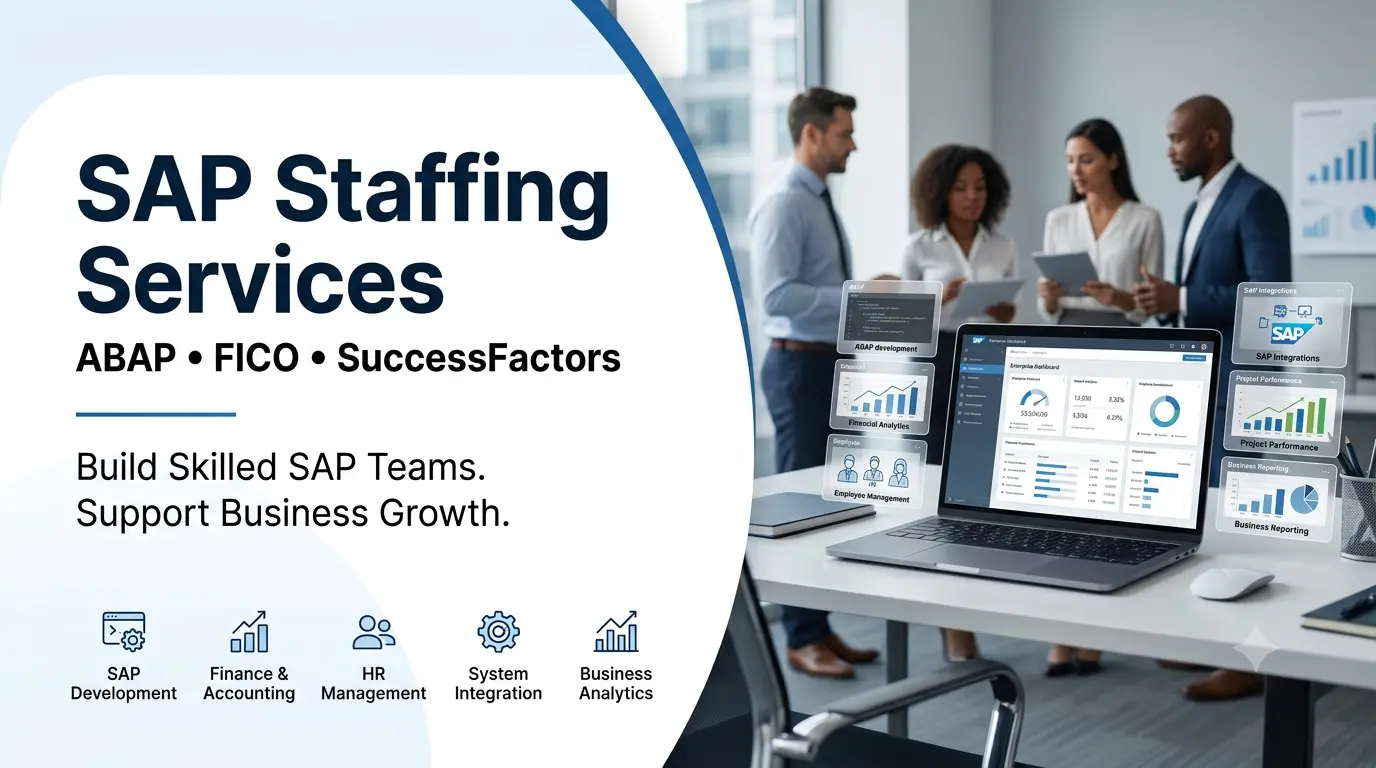
That is where SAP ABAP Developer Staffing, SAP FICO Consultant Staffing, and SAP SuccessFactors Staffing can give US organizations more flexibility. Instead of building a large permanent team for every project, businesses can bring in specialized professionals based on their current needs, project timelines, and technical requirements.
Why Specialized SAP Talent Matters
SAP environments connect critical business functions, so even a small configuration or development issue can have a wider impact. A change in finance processes, for example, may affect reporting, procurement, compliance, or other connected workflows.
Specialized consultants understand these relationships and can contribute without requiring months of basic training. For a US company moving through an SAP implementation, upgrade, integration, or optimization project, targeted staffing can help fill expertise gaps while keeping existing employees focused on their core responsibilities.
Consider a manufacturing company preparing for an SAP S/4HANA transformation. Its internal IT team may understand the business extremely well but lack enough ABAP development capacity. Bringing in experienced developers for the project can help the company handle customization and integration work without permanently expanding its internal workforce.
SAP ABAP Developer Staffing for Technical Projects

ABAP remains an important skill for organizations that need to develop, enhance, integrate, or maintain SAP applications. Experienced ABAP developers can work on custom reports, interfaces, forms, enhancements, APIs, data migration utilities, and other technical requirements.
SAP ABAP Developer Staffing allows businesses to access this expertise when a project requires it. This can be particularly useful when an organization has a temporary development backlog or needs additional technical capacity during an SAP transformation.
For example, imagine a US distribution company migrating several legacy applications into a modern SAP environment. Its permanent developers are busy maintaining existing systems while the migration team needs additional hands. A qualified ABAP developer can help create interfaces and custom functionality while the internal team continues handling day-to-day operations.
The key is to define the technical requirements before hiring. Businesses should consider SAP version, development environment, integration requirements, industry experience, project duration, and the specific ABAP skills required.
SAP FICO Consultant Staffing for Finance Teams
Finance is one of the areas where SAP expertise can directly influence business operations. SAP FICO connects financial accounting and controlling processes, helping organizations manage areas such as general ledger, accounts payable, accounts receivable, asset accounting, cost centers, profitability analysis, and financial reporting.
SAP FICO Consultant Staffing can help companies bring specialized finance and SAP knowledge into projects that require configuration, optimization, migration, integration, or ongoing support.
Suppose a growing US organization is consolidating several business units into one SAP environment. Different entities may follow different accounting processes, reporting structures, or approval workflows. An experienced FICO consultant can help evaluate those processes and support a standardized approach aligned with the company’s business requirements.
The right consultant should understand both SAP functionality and practical finance operations. Technical knowledge alone is not enough. Successful FICO projects depend on understanding how accounting teams actually work and how SAP processes affect reporting, controls, and decision-making.
SAP SuccessFactors Staffing for Modern HR Operations
Human resources has also become increasingly technology-driven. Companies want efficient employee onboarding, accurate workforce information, streamlined talent processes, and convenient self-service experiences.
SAP SuccessFactors supports many of these HR requirements through cloud-based human capital management capabilities. However, implementing or optimizing these solutions requires professionals who understand both the platform and the organization’s HR processes.
SAP SuccessFactors Staffing helps companies access specialists for implementation, configuration, integration, testing, data migration, optimization, and support. This can be especially valuable for organizations replacing fragmented HR systems or expanding their workforce across multiple locations.
For instance, a US company with employees in several states may want to standardize onboarding and employee data management. A SuccessFactors specialist can help the project team evaluate requirements, configure appropriate processes, coordinate integrations, and support testing before the solution reaches employees.
When Should a Business Consider SAP Staffing?
Not every organization needs additional SAP professionals all the time. Staffing becomes particularly useful when demand temporarily exceeds internal capacity.
Common situations include SAP implementations, S/4HANA transformation projects, system upgrades, acquisitions, data migrations, integrations, application modernization, and periods of increased support demand. Staffing can also make sense when a company needs a rare skill that would be difficult to justify hiring permanently.
The advantage is flexibility. A business can build a team around the actual project instead of trying to maintain every possible SAP skill internally.
How to Choose the Right SAP Staffing Partner
Choosing a staffing partner should involve more than checking resumes. Start by defining the project scope, required SAP modules, technical environment, expected deliverables, timeline, and level of experience.
Next, evaluate whether candidates have relevant project experience. Someone who has worked with SAP in a similar industry or business environment may understand common challenges faster than someone with only general platform knowledge.
Communication also matters. A good staffing relationship should provide clear expectations around responsibilities, availability, project milestones, documentation, and collaboration with internal teams.
For US organizations, it is also worth considering time-zone compatibility, communication practices, contractual arrangements, and the ability to scale staffing as project requirements change.
Benefits of a Flexible SAP Staffing Model
A flexible staffing model can provide several practical benefits. First, businesses can address skill shortages without immediately committing to permanent headcount. Second, specialized professionals can be added during critical project phases and reduced when demand falls.
It can also help internal employees avoid becoming overloaded. Instead of asking a small IT team to manage production support while simultaneously delivering a major transformation, organizations can supplement the team with specialists.
Most importantly, staffing should be viewed as a capability strategy rather than simply a hiring shortcut. The goal is to put the right expertise alongside the right internal teams at the right stage of a project.
Building a Balanced SAP Project Team
Successful SAP projects rarely depend on one type of professional. Technical developers, functional consultants, business users, project managers, integration specialists, and internal stakeholders often need to work together.
For example, an ABAP developer may build an interface, while a FICO consultant validates how financial data should flow through the process. A SuccessFactors specialist may handle HR requirements while integration experts connect the HR platform with other enterprise systems.
This collaboration is why businesses should plan staffing around project outcomes instead of individual job titles. The best team is the one whose combined skills match the organization’s actual requirements.
Conclusion
SAP expertise can make a major difference when organizations are implementing, upgrading, integrating, or optimizing enterprise systems. SAP ABAP Developer Staffing, SAP FICO Consultant Staffing, and SAP SuccessFactors Staffing give US businesses practical ways to access specialized skills without automatically expanding permanent teams.
The right approach starts with clear project requirements, relevant experience, strong communication, and a staffing model that can adapt as business needs change. With those elements in place, organizations can strengthen their SAP teams and move important projects forward with greater confidence.
Planning an SAP project or facing a temporary skills gap? Evaluate your current requirements, identify the SAP expertise you need, and choose a staffing approach that aligns with your timeline and business goals. A well-planned team can help turn SAP investments into measurable operational value.
Connect with Us on LinkedIn.











Leave a Reply